Theeb
(United Arab Emirates/Qatar/Jordan/UK, 2014)
directed by Naji Abu Nowar
written by Naji Abu Nowar and Bassel Ghandour
In 1916, there were Bedouin tribes living in the Ottoman Empire who were so unconnected to the outside world that they had no idea World War I raged nearby. Theeb tells the story of one such fictional tribe and the results of contact with World War I through a British officer who needs a Bedouin guide.
Theeb (Jacir Eid Al-Hweitat) is a young boy, son of a late sheikh, who lives a sheltered life with his older brothers in the desert of Hijaz, in what is now Saudi Arabia. He is young and innocent, but also clever and observant. So when a British officer in search of a Bedouin guide (Jack Fox) is brought to their camp by an interpreter, Theeb is entranced with the visitor. He watches him shave, asking in Arabic, "Are you a prince?" He attempts to find out what is in the mysterious wooden box that the officer protects so fiercely.
When his brother Hussein (Hussein Salameh Al-Sweilhiyeen) agrees to act as guide, Theeb sets off after them, following at a distance and only revealing himself when it is too late for them to send him back.
Thus the little boy gets his wish, to have an adventure--and maybe find out what is in the wooden box.
But the deserts of the Ottoman Empire are not a safe place in 1916. There are raiders and revolutionaries, and they are merciless. The journey to the officer's destination is tense and risky and soon everything goes sideways. At one point, Theeb is forced to rely on an unpleasant mercenary (Hassan Mutlag Al-Maraiyeh). Can he trust this stranger?
Most of the actors in this movie are amateurs who had never acted on film before. They do an excellent job, particularly Jacir Eid Al-Hweitat. He has a mobile, appealing face, and he does a great job of portraying the resourceful, tenacious main character. The Stranger is similarly tenacious, but far less sympathetic. The desert provides a beautiful but forbidding setting, with vast stretches of sand and deep canyons of stone. One is never sure who will survive in that setting. It is worth watching the movie to find out.
Sunday, January 31, 2016

Sunday, January 10, 2016
movie review: The Second Mother [Que Horas Ela Volta?]
The Second Mother (original title: Que Horas Ela Volta?)
(Brazil, 2015)
written and directed by Anna Muylaert
The "second mother" of the movie's English title is Val (Regina Casé) , a live-in housekeeper, cook and nanny for a wealthy family in São Paolo. She has practically raised the son of the family, Fabinho (Michel Joelsas), and he confides his happinesses and his sadnesses to her as though she is his "second mother," often preferring her to his biological mother, Bárbara (Karine Teles), or his father, Carlos (Lourenço Mutarelli). However, Val is also in many ways only a "second mother" to her own biological daughter, Jéssica (Camila Mardilá), whom she left back home in her rural village. Val has sent money back home for over ten years to the friend raising Jéssica, while she has essentially raised another family's son.
However, one day Val receives a phone call she has been wishing for: Jéssica wants to come to São Paulo to live with her mother and take the university entrance exams. She intends to apply to FAU, a very prestigious design and architecture college. Val asks her employers if it is all right that her daughter joins her for a while, and they agree amiably enough, saying that Val is very important to them, and by extension, so is Jéssica.
However, upon arrival, it becomes clear that although Val is willing to hew to the unspoken rules that govern her relationship with her employers, Jéssica has no notion of what those rules might be, and worse yet, does not care to follow the ones she is told about. Unsurprisingly, this causes tension for everyone. At one point, Val tells her daughter in exasperation, "You think you're better than everyone else!" Jéssica replies, "No, I don't. I just don't think I'm worse than anyone else." Jéssica's arrival disrupts everyone, and she is the catalyst for some uncomfortable soul searching on the part of the three adults.
Director Anna Muylaert creates scenes with a light hand, often using humour that underscores the tension that runs right below the surface. She cleverly leads the audience to suspect one thing is going to happen, then surprises by defying our expectations. She also makes good use of cinematographic techniques like static shots (but not overusing them so that the film feels gimmicky). The actors are also superb, particularly Casé and Mardilá. They provide a moving and convincing portrayal of a mother and daughter who mean a lot to each other, but have been estranged for a long time, with all the baggage that creates.
Although The Second Mother is fairly long (112 minutes), I found myself absorbed by the story the entire time. Highly recommended.
(Brazil, 2015)
written and directed by Anna Muylaert
The "second mother" of the movie's English title is Val (Regina Casé) , a live-in housekeeper, cook and nanny for a wealthy family in São Paolo. She has practically raised the son of the family, Fabinho (Michel Joelsas), and he confides his happinesses and his sadnesses to her as though she is his "second mother," often preferring her to his biological mother, Bárbara (Karine Teles), or his father, Carlos (Lourenço Mutarelli). However, Val is also in many ways only a "second mother" to her own biological daughter, Jéssica (Camila Mardilá), whom she left back home in her rural village. Val has sent money back home for over ten years to the friend raising Jéssica, while she has essentially raised another family's son.
However, one day Val receives a phone call she has been wishing for: Jéssica wants to come to São Paulo to live with her mother and take the university entrance exams. She intends to apply to FAU, a very prestigious design and architecture college. Val asks her employers if it is all right that her daughter joins her for a while, and they agree amiably enough, saying that Val is very important to them, and by extension, so is Jéssica.
However, upon arrival, it becomes clear that although Val is willing to hew to the unspoken rules that govern her relationship with her employers, Jéssica has no notion of what those rules might be, and worse yet, does not care to follow the ones she is told about. Unsurprisingly, this causes tension for everyone. At one point, Val tells her daughter in exasperation, "You think you're better than everyone else!" Jéssica replies, "No, I don't. I just don't think I'm worse than anyone else." Jéssica's arrival disrupts everyone, and she is the catalyst for some uncomfortable soul searching on the part of the three adults.
Director Anna Muylaert creates scenes with a light hand, often using humour that underscores the tension that runs right below the surface. She cleverly leads the audience to suspect one thing is going to happen, then surprises by defying our expectations. She also makes good use of cinematographic techniques like static shots (but not overusing them so that the film feels gimmicky). The actors are also superb, particularly Casé and Mardilá. They provide a moving and convincing portrayal of a mother and daughter who mean a lot to each other, but have been estranged for a long time, with all the baggage that creates.
Although The Second Mother is fairly long (112 minutes), I found myself absorbed by the story the entire time. Highly recommended.
Monday, November 02, 2015
Newborn Hat Pattern: Tut Tut, Looks Like Rain
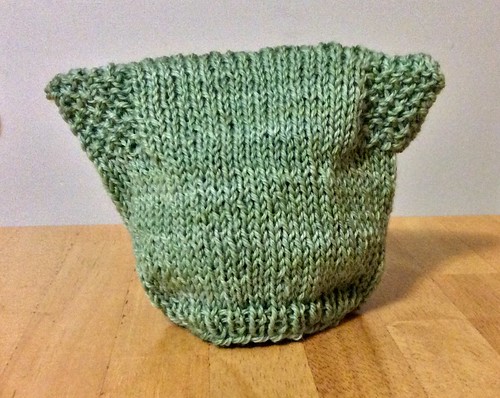
If you would prefer a PDF of this pattern, you can download it here from Ravelry.
MATERIALS
- Approximately 30 yards (28 metres) of sport weight yarn
- US 3 (2.5 mm) set of double pointed needles, or suitably long circular needle for Magic Loop
- Yarn needle
- 4 stitch markers (one unique)
GAUGE
24 sts = 4 ins
32 rows = 4 ins
- CO 60 sts.
- Join to knit in the round, being careful not to twist stitches. Place unique marker to indicate beginning of rnd.
- Rounds 1 to 3: K1, P1 around.
- Knit in stockinette (K all sts) for the next 20 rounds.
- Round 1: (K1, P1) 3 times, PM. k18. (P1, K1) 3 times. PM. Knit to end of rnd.
- Round 2: (P1, K1) 3 times, K18, (K1, P1) 3 times. Knit to end of rnd.
- Repeat Rounds 1 and 2 five times more. You are making two seed stitch squares at the top corners of the front of the hat.
- Put first 30 sts (front of hat) on one dpn and last 30 sts (back of hat) on another needle. Use Kitchener Stitch to graft front and back of hat together.
- Break yarn and weave in ends. You're done!
GLOSSARY
CO = cast on
K = knit
P = purl
rnd = round
sts = stitches
dpn = double pointed needle
PM = place marker
(This pattern is free for personal use; please do not sell hats made from this pattern or use it without attribution to the author.)
Subscribe to:
Posts (Atom)