Wednesday, September 20, 2017

Netflix Review: Peaky Blinders

My neighbour asked me today if the BBC series Peaky Blinders is like Downton Abbey. Now, if I had to think of a show that was more unlike Downton Abbey despite sharing a similar time period and country of origin, I'd be hard pressed to top Peaky Blinders. We recently watched all three seasons available on Netflix and holy hell, it is quite the ride.

It's set in Birmingham, with the first season taking place in 1919. The Peaky Blinders are a violent mob run by the Shelby crime family, headed by Tommy Shelby (the oddly beautiful Cillian Murphy). The Shelbys run the cops, the bars, and the factories in Birmingham and if you cross them, they'll cut your eyes out by whipping you across the face with the razor blades concealed in the peaks of their tweed caps. (Hence: Peaky blinders.)

Definitely not Downton Abbey. 

The series is gorgeously filmed, with grimy but somehow warmly glowing shots of the rough streets of Birmingham. The soundtrack is full of anachronistic music from the likes of Nick Cave (he does the theme song), PJ Harvey, David Bowie, and Leonard Cohen.  I found it jarring at first, but weirdly, it works. The acting is excellent, particularly from Cillian Murphy, Paul Anderson (Arthur Shelby), and Helen McCrory (Aunt Polly). 

The characters are unlikeable at first (and sometimes throughout), but you find yourself cheering for them eventually anyway, almost against your will. Tommy is a conundrum: very intelligent, coldly calculating,but also, paradoxically, a romantic and a decorated war hero. Tommy's brothers, Arthur and John, are on the one hand sheer brutes but they, too, are revealed to be more than just one note characters. The women of Peaky Blinders are also fascinating, fully rounded characters with a lot of backstory and wills of iron, especially Tommy's Aunt Polly, the family matriarch. Polly, played by the fabulous Helen McCrory, is a pragmatic, seemingly cold woman who has depths that are revealed slowly over the course of the series. Grace, the Northern Irish woman with the lovely singing voice who applies to be barmaid at the boys' pub, the Garrison, is similarly much more than she appears to be at first. The thing is, no matter how awful the Shelbys are, there's always someone else who is worse. At one point, this honour goes to Sam Neill's sociopathic Police Inspector Campbell; at another, to Alfie Solomons, Tom Hardy's bombastic leader of a Jewish London gang.

One aspect of the show I find quite interesting and am curious as to its authenticity is its portrayal of Roma culture (the Shelby family are part Roma and self identify as "gypsies," with deep ties to that community). There is a lot of discrimination against Roma in Britain, and there are many reminders of this in the uneasy relationship the Shelbys have with that side of their heritage. 

Although there are some over the top moments and ridiculous plot twists, if you can stomach the Sopranos-esque violence, Peaky Blinders is compelling period storytelling. I'll be awaiting the fourth season with eager anticipation.  


Sunday, January 15, 2017

Netflix review: Orange is the New Black

https://blogger.googleusercontent.com/img/b/R29vZ2xl/AVvXsEgTJwMzUfl2mKTzJOhO5BY5uj7iF0ztAokA32TWlHWZnSJvBLa_ruoINAAF86AY7Pw1mYmKeJwnrroEDJveLYxaxUIN46qm5vIBMraLO04kXny76Gw2rmIhmNi_ttGBlv0hPlqQ/s1600/orange-new-black.jpg
Netflix promotional poster for Orange is the New Black

A few years ago I listened to an episode of The Moth podcast where author Piper Kerman told a story about her time in prison. Kerman had been an upper middle class graduate of an all women's college, working as a PR person, when she was sentenced to prison for a previous drug smuggling conviction. At the end of the episode, the announcer mentioned that Kerman had written a book called Orange is the New Black about her experiences in prison, and that there would be a new series on Netflix created by Jenji Kohan (Weeds) based on a fictionalized version of that book.

We started watching the series and I honestly didn't have a lot of high expectations for it. Although it seemed possible from Kerman's Moth episode, I wasn't entirely sure if Kohan's take on the story would address issues like classism and racism. I felt slightly uncomfortable at the idea of being entertained by a story of women in prison if it did not address the problems inherent in the system.

However, I was pleasantly surprised, and as I've watched each season in turn, my respect for the show has grown. For one thing, it is consistently the best show on TV (Netflix, cable, whatever) that features such a diverse group of women. There is a wide range of races, ages, body types, sexual orientations, gender identities, social classes, and situations represented. It is so important to see such a vast range of women interacting with each other, forming friendships and relating to each other, rather than always having their stories filtered through the eyes of men, if they are told at all. It is something I absolutely love about the show.

And it does not shy away from some fairly intense issues. Some I can think of off the top of my head:

  • the overrepresentation of women of colour in prison
  • treatment of trans women in prison
  • abuse of power by guards
  • rape
  • rights of pregnant women in prison
  • racial profiling
  • homophobia
  • ageism
  • labour issues--treatment of prisoners as indentured labour for large corporations; treatment of guards' unions; privatization and for-profit prisons
  • the proliferation of prison as a moneymaking venture in the United States
  • treament of mentally ill prisoners
  • treatment of mentally ill people in society in general (thus causing some to end up in prison when it isn't the best place for them and they actually need treatment
The show isn't without its flaws (which are unfortunately kind of hard to talk about without revealing fairly significant plot points)--one way in which it could improve is to hire some writers of colour--but overall it is one of the best shows I have seen to discuss women's issues and to portray such a vibrantly diverse cast of characters. I am eagerly awaiting the next season.

Saturday, November 05, 2016

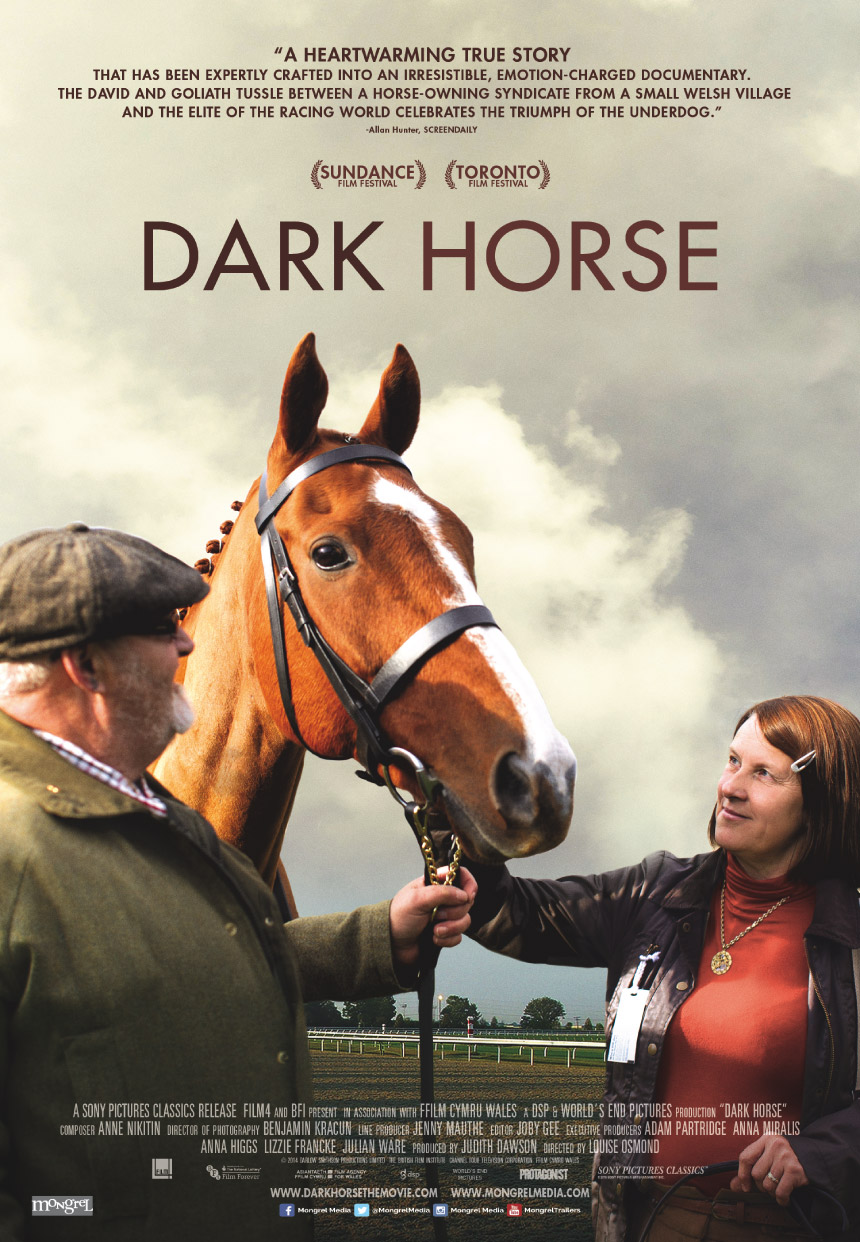
movie review: Dark Horse

dark-horse-poster-lg  

Dark Horse: The True Story of Dream Alliance  
(UK, 2015)  
director: Louise Osmond

I have a particular soft spot for British underdog movies. You know the ones I'm talking about: Billy Elliot, The Full Monty, Made in Dagenham. Those are fictional or at least fictionalized narrative films, but even though Dark Horse is a documentary, it bears remarkable resemblance to those other movies.

In 2000, a Welsh woman named Jan Vokes convinced 30 of her fellow villagers to form a syndicate and pool their money together to breed and raise a racehorse. As her husband notes, once Jan has put her mind to something, you can't stop her. And thus begins the story of Dream Alliance, the horse who came from dubious stock and was raised on an allotment, but went on to remarkable success.

The movie makes good use of Jan and her fellow owners' considerable charm. They are fully aware that the world of horse racing is generally reserved for the wealthy and the titled. Part of their pride comes from being working class and having stood up against the snobs--and proving themselves to be as good if not better. There are some very amusing interviews where the top class trainer the syndicate chose for Dream Alliance admits to his initial skepticism and patronizing thoughts about the horse's chances of ever running in a real race, never mind winning. His account of his change of heart is very touching and genuine.

That is actually a good way to describe this movie overall: touching and genuine. I thoroughly enjoyed it and had a smile on my face when I left the theatre. Definitely recommended.